Thursday, April 29, 2010

The Road


When you live on a dirt road, you tend to drive slowly. Dirt isn't the best surface and when there's only room for one car on the road half the time it's good to be careful. I can't even tell you how many times I've come around a corner and about had my heart jump out of my chest because there's a big 'ole car heading straight for me on my side of the road. Today I came across this big grader. The county grades the road twice a year. Once in spring and once right before hunting season so the hunters will have a nice smooth driving experience while they're pointing their shotguns out their car windows. (Okay, I don't like hunting season if you can't tell. They should at least go walk to hunt for their kill. I mean, come on. I think car hunting is illegal anyway, but I digress.)

When they grade the road they basically scrape off the top of the road and then smooth it back on. Sounds silly, and it kind of is, but it definitely takes out the washboardy bumps and makes my neck a little less sore for a while. It takes about a week for the road grading to be completed in which time I have to drive the hump.


Being a one and a half lane road there isn't always enough room for the car to fit on the side of the dirt hump the grader makes. It's lovely when the pile in the middle is so high that it scrapes against the bottom of the car. It gets really exciting when there's a boulder. And so go the days on the mountain. Pretty exciting, huh.

Tuesday, April 20, 2010

A Different Way to Dummy a Picture Book

When writing a picture book it's good to dummy it up to see if there are enough unique scenes and good page turns. I've done it lots of times, torn a bunch of pieces of paper up into squares, stapled them together into a little book, cut and pasted my words onto the pages. It's fun and informative, but can time more time than I have, so I've come up with a different way to "dummy" my books.

Needing to write down a story real quick one day, and having ideas of where I wanted the art and page turns to be, I decided to get a few pieces of blank paper. I drew 32 squares. Number one by itself, number two and three together, and so on until the last page, 32, as a single square.(This is because 32 pages is the standard for picture books and the first and last page generally stand alone.) Then I wrote my story in the boxes.


Yes, I had to write small, but it fit just fine. I used pencil so I could move text around. I drew little sketches of the artwork I saw in my mind. No, I would not send it out with artwork, I'm not that good. But I can see the possibilities. I can see my words as a book, as a whole, on just a couple of pages. I can see where the writing and imagery are good and where the story needs to be improved.

It's nothing fancy, but it works. If you have even less time(as seems to happen periodically in life!), you can number your words according to page number. But I think this works better, and really doesn't take any extra time. Drawing the squares and doodles gives you something to do while you think.

If you have a different sort of way to dummy picture books I'd love to hear about it!

Wednesday, April 14, 2010

Creating a world in a picture book

by John Lechner

How does an illustrator create a world? There are many ways to do this, and every illustrator has their own individual tricks and techniques. Here are a few of the methods I use to create a world in my picture books.


1. Establishing Shot
This is a term often used in filmmaking, but pertains to books as well, and helps create context for your story. In my book A Froggy Fable, the setting and the frog's place in it was very important to the story, so I wanted to establish it early. You don't always need to do this at the beginning of the book, as long as it comes at a point when it's important to the story in order to give continuity to the world.


2. Time of Day/Year
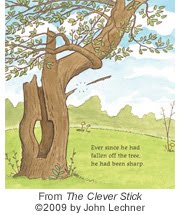
When does your story take place? A specific time of day or season of the year can really help make a world come together. My book The Clever Stick takes place in the springtime. My first Sticky Burr book takes place in the summer and the second one in the autumn, and I tried to draw each scene accordingly.


3. Different Perspectives
Different viewpoints – high/low/near/far – not only add variety to scenes, but allow the viewer to see more of your world, and can heighten the drama. Looking down from above, up from below, or from the viewpoint of your main character, can completely change the flavor of your story. But don't go crazy, try to use perspective where it helps the story.


4. Atmosphere
By atmosphere I mean both the physical and the psychological one – are you depicting a happy scene or a scary one? Giving the viewer an emotional reaction to a scene draws them in and makes them a part of it. In this image from Sticky Burr: The Prickly Peril, I used a limited palette and jagged lines to enhance the mood.


5. Continuity
It's important to make your world and your characters look consistent from page to page. But consistency of style is often even more important than consistency of character. If the overall style of your drawings is consistent from page to page, your world will feel like it all fits together. Style is not easy to develop, and is best when it comes naturally. I find when I focus on the story and climb inside of it, the style follows on its own.

Those are just some of the ways an illustrator can create a tangible and believable world in a picture book. Can you think of others? Leave your suggestions in the comments!

You can learn more about author/illustrator John Lechner at his Illustrator of the Month interview and on his website www.johnlechner.com

Saturday, April 10, 2010

Unpredictable

Life is unpredictable. Yes, we all know that but I've really been experiencing it lately. The sheer amount of weird things happening in my life is bordering on comical. And really, when life seems bad what can you do but laugh and be thankful that things aren't worse?

Sometimes such random things can happen. Things you would never dream of and certainly not expect or watch out for. It, of course, makes me think of writing. In good books unexpected and seemingly random things can happen, but they work in the context of the story to help the character grow. And we're never done growing. There's always more stories to tell.

If things can get worse, they certainly can get better. Here's to positivity! And perhaps a few good book ideas.

Friday, April 2, 2010

Illustrator of the Month--John Lechner

This month I'm celebrating John Lechner! He's here today to share some insights about being an author/illustrator, and he knows what he's talking about. John is a multitalented illustrator, author, animator, designer, puppeteer, and musician. He has four books to his credit so far, A FROGGY FABLE, THE CLEVER STICK, STICKY BURR: ADVENTURES IN BURRWOOD FOREST, and STICKY BURR: THE PRICKLY PERIL all published by Candlewick Press, as well as loads of great interactive material. Currently John is the art director at Peter H. Reynolds' children's media company, Fablevision. I'm very happy to feature John as April's Illustrator of the Month.

I assume people with great artistic talent always had it. Were you always good at drawing, even as a kid? When did you know you wanted to create children’s books?

I’ve always loved to draw, and I was always encouraged as a child. I wrote and illustrated my first book in first grade, about explorers who fall into the ocean and escape from a whale. I always loved books and wanted to be an illustrator like those I admired (Maurice Sendak, N.C. Wyeth, Bill Peet, Arthur Rackham.) I studied art and creative writing in college, but didn’t really find my voice until much later.


How did you develop your illustration style?

It just developed naturally over the years, it’s an odd mixture of naturalistic watercolors and simple line drawings. As I became more busy through the years, I drew faster and that helped to free up my style. I think it also comes from the things you draw, and since my stories often involve animals or nature, that also influences my style. I don’t like drawing buildings, I’m more at home in the forest.


When both writing and illustrating a book, which comes first for you, the story or the art?


The words usually come first. I might draw a quick sketch to set the scene in my mind, but I usually write out the story as it comes into my head. When I get a story idea, I don’t think about whether it might be a book, I just write the story and see where it goes. Some ideas don’t go anywhere, but sometimes they end up better than you thought. If I think a story has potential, I might create a web version to try it out. That’s how A Froggy Fable and The Clever Stick got started.


When submitting a book as the author/illustrator, do you complete the illustrations before submitting or do you submit a dummy?

I usually submit a rough sketch dummy along with the typed manuscript. A picture book typically evolves a lot from the time it is accepted until the time you do the final illustrations. The publisher will want to consult with you on the text, the size of the book, the number of pages, and the layout. So illustrating the entire book beforehand is not practical.


The purpose of the sketch dummy is to convey your vision of the book, and give the publisher a rough idea of how it might read. But when your book is accepted by a publisher, their designer will likely make a new dummy with suggestions for making the layout stronger, just as your editor will make suggestions for strengthening the text. There is a lot of discussion and revision before the final layouts are ready and you can start the final illustrations.


Your STICKY BURR books are part picture book, part comic book. What made you decide to go that route for these stories?

I originally envisioned the burrs as comic characters, because I wanted the stories to have a lot of action and visual humor. I started doing the Sticky Burr web comic over ten years ago, which has evolved into the current version you see today. I envisioned the books as a combination of a comic and a picture book because I wanted them to be a little different. By inserting pages of Sticky Burr’s (or Scurvy Burr’s) journal throughout the comics, it not only allowed me to elaborate on the characters and their world, but it also provided a nice break in the story, making it easier to suggest the passing of time or changing of location, which otherwise would have been harder in such a short comic. I added the map and other things to help create an entire world for these characters.


I have to ask. Why a burr?

When I was young, my brothers and sisters and I would spend a lot of time in our backyard. It had squirrels, birds, dragonflies, grasshoppers -- a bit like Burrwood Forest. We also had bushes that grew burrs on them, and we always called them sticky burrs. It wasn’t until I was an adult, and thinking back to those years, that I thought the burrs would be great characters. I started writing stories about them, and they evolved into the world you see today.


Do you think it’s easier as both the author and illustrator of a book to get your story across?


Personally, I enjoy having control over the story and illustrations, because I tend to think of them together. I visualize the images in my head as I write. Though there are also advantages to working with someone else, as they often think of ideas that you didn’t.


You also create films and interactive games. Does this take a whole different skill set or does it complement your book writing and illustration work?


Like books, films and interactive games also involve storytelling with images, but it’s really a different way of thinking. You’re thinking in real time, with real pacing. The storytelling techniques are different too. That’s why picture books that use still images from a film usually fall flat, because those images weren’t meant to stand alone, they were meant to be shown in connection with a thousand other images. So as an artist it can be challenging to shift from printed books to films and interactive stories, as you have to shift your brain into another way of thinking. But they all can inspire and influence each other.


Continuity of the looks of the character is so important. How do you achieve this page after page?

Continuity is very difficult, it takes a lot of erasing and comparing images side by side. However, you also don’t want to be too tied down to making your characters perfect, you also want them to be alive. Some of my favorite illustrators hardly have any continuity, yet they have so much life and energy in their art (Ludwig Bemelmans is a perfect example.) Continuity of style is often more important than continuity of specific characters. As long as the world you create is consistent throughout, the characters will appear more consistent.


If you use an additional illustrated story line in a book, do you decide on it purposefully or does it grow organically?

It’s different with every book, but usually it happens in the illustration stage. For instance, in Sticky Burr: The Prickly Peril, there are two burrs that both want to juggle, and one of them steals the juggling balls from the other. In the final page, they are seen juggling together. This is totally unrelated to the main storyline, yet it helps reinforce the malcontent of the burrs early on, and the camaraderie they feel at the end.


What advice would you give to aspiring author/illustrators trying to break into the market today?

It’s a very crowded field, but it’s also an evolving one because of new media and markets. Networking is one of the best ways to get connected with people in the field and get seen by an editor or art director. SCBWI conferences are great, and there are so many writer conferences and comic conferences where you can meet people and learn from them. Keep an eye out for new small publishers, which are often more receptive to new authors. Don’t be afraid to try new things, such as ebooks or web comics. And never stop working and improving your art, try to work twice as hard as everyone else.


Want to tell us about what you’re working on right now?

I’m finishing up my first novel, which I hope will find its way to publication. I’m also drawing a weekly web comic about Sticky Burr and his continuing adventures. I also have a blog about art and nature called The Untended Garden, where I write about how artists and writers are influenced by nature.


I’ve also been working on an interactive story, something that combines my interest in books, animation and interactive games. It’s a story without words, where the user advances the action, following a character as he journeys through a mysterious and deserted world. Although it’s interactive, it’s still a fairly linear story, with a beginning, middle and end. I’ve always been interested in the possibilities of interactive storytelling, and trying to push the boundaries of what can be done. I hope to unveil the project this spring.

You can learn more about John and see tons of his work at his website, http://www.johnlechner.com/ And check back this month for more from John!


Sunday, March 28, 2010

The Unread - Interview with Marci Dunn


Marci Dunn is a writer in the heart of the Bluegrass State. She's a single mom to an amazing nine year old artist. (His work is featured as her Twitter background.) She loves to travel. Her favorite city is New Orleans for its historical beauty. Her favorite moment (outside anything to do with her son) was sitting at Glacier Point, in Yosemite, looking out at Half Dome where she realized how incredibly small we really are and how beautiful the world we live in is. I met Marci on Twitter, where we tend to hang out just a little too much I dare say. I wanted to know more about her writing so I asked her to be this month's victim for the Unread.

When did you start writing and why in the world would you want to do such a thing?

I started seriously putting words on paper about four years ago and I don’t know why I didn’t do it sooner. It is so freeing to get the stories out of my head and stored somewhere else. You might say I have an over-active imagination.


How do you make the time to write? Don’t you have other things to do?

I write whenever I have a spare second: my son’s tutoring lessons, football practice, soccer practice, basketball practice…you get the picture. Right now I get some of my best stuff done at night after he goes to bed.

Since completing my first NaNoWriMo last November, I’ve been training myself to write at home, butt firmly planed in chair. In the past I’ve had to leave my house to write, too many distractions at home. But if NaNo taught me anything it was that I can write at home. I can block out distractions or at least learn to move through them.


What sorts of stories do you write?

I write YA Fantasy. I’ve been making up stories in my head ever since I first saw PETER PAN as a child. I love creating new worlds totally different than the normal hum drum one I live in. I guess you could say I love the escapism… it is very freeing.


Do you do much submitting?

I’ve not submitted anything yet. I hope to finish revisions on my current WIP by summer so that I can begin the submitting process. The thought of writing a query letter makes me break out in hives. Summarizing 75K words on one page is very overwhelming to me.


There’s little glory for unpublished writers. What keeps you going?

I was talking with friend about this just last night. Yes there may be little glory for most, but if I could spend the rest of my life creating my art and possibly making others happy by sharing it with them then that is all the glory I need. I make very little money now so there is big deal there.


What do you enjoy most about writing?

It is mine and mine alone. I love the fact that I create something that was not there before. I love watching my characters come to life. They seem so real to me... they are real to me. I can remember, I cried when I finished my WIP. It was as if I took the journey with them. I shared their joy, their sadness, their exhaustion. I was so happy to see them to the end of their journey.


What are your writing goals and what have you done to further them?

My first “big girl goal” was to finish my current WIP, and I have done that. I now am suffering through revisions. They are nowhere near as fun as the initial writing process, but necessary. I’ve got to get a thicker skin to handle the criticism needed to make my story better. I’m getting better… I realize it is all part of the process.


Do you have any favorite writing websites?

I would have to say Twitter is my favorite. I say this because through Twitter I am introduced to so much knowledge. I have learned so much in the last nine months about the publishing industry. There are so many helpful people.


Care to tell us a bit about what you’re working on now?

My current project is a four part YA Fantasy called the CISTINE MEDALLION. The first book is THE GREAT PROPHECY. It is a total adventure story set in my little world of Armor. Three teens run for their lives and attempt to answer the age old question of destiny vs. choice.


How far would you go to get your book published?

I’m not sure how to answer this. I know being a writer is what I’m meant to do…nothing else has ever felt this right.

(Marci! You're just supposed to say you'll eat raw fish guts or would jump off a diving board into a pool of cheese whiz or something like that. ;-)


And here’s what I really want to know, if you could live in any book which one would it be and why?


Oh I’m going to get mushy here… Pride & Prejudice. I would so be Elizabeth Bennet in a heartbeat.

You can connect with Marci on Twitter where she's MRDunn12. She also has a blog she shows little love to at marcidunn.wordpress.com But hey, writing has to come first!

Saturday, March 27, 2010

Picture Perfection


It occurred to me the other night as I opened up Otto Grows Down, illustrated by Scott Magoon and written by Michael Sussman, to read it for the hundredth time or so, that the opening illustration is perfect. The first illustration is on the endpapers so the instant you open the book, there is baby Anna, bigger than life-size, mouth wide open, wailing.

When that picture stares you in the face, you can feel it. The way Otto feels about his baby sister. She's loud and annoying and taking over everything. It sets up the book perfectly. It gets you ready to symphathize with Otto and the problem of his baby sister being born. It's picture perfection.