Showing posts with label authors. Show all posts

Sunday, December 2, 2012

Bran Muffins of Doom? An Interview with Author & Illustrator Marty Kelley

Marty Kelley is a recovering second grade teacher living in New Hampshire. What does one do when recovering from being a teacher? Write and illustrate for kids, of course!

Marty has illustrated a number of books for kids, two of which he has also written. He is represented by Red Fox Literary Agency. Marty is frolicking by to give us the low down on his writing and illustrating. I even asked him how his unique book tour and how he feels about illustration notes.

How long have you been writing and illustrating for kids?
My first book, Fall Is Not Easy was published in 1998, so it’s been a while. Before that I worked as an illustrator and cartoonist for several small newspapers and magazines.

What are some of your favorite things to illustrate?
People, people, people. I love painting them. When I’m not doing children’s books, I actually create commissioned fine art portraits of people.

Do the things you enjoy illustrating affect what you decide to write about?
I have a terrible time with landscapes and tend to try to have my illustrations happen indoors, but that obviously doesn’t always work out. I don’t consciously adjust my writing to what I think the illustrations will be. In fact, it has happened that I’ve had a story written and then realized that I have no idea how I’m going to do the illustrations.

As an illustrator, how do you feel about an author putting illustration notes in a manuscript?
Unless it’s something very important to the story, I prefer that the author sit back and let me do my job. I completely understand how nerve-wracking it must be to not have any control over the look of something that you worked so hard on, but when authors start micro-managing, all the fun of creation gets sucked out of it for me. I’m glad to say that it’s only happened once or twice.

You did a tour of seafood restaurants for CRUSTACEAN VACATION, (which is awesome!) how did that opportunity come about? Do you think alternative venues are a good avenue for authors and illustrators to use when promoting their books?
That was a weird one and while I enjoyed it, I have had my fill of chowder for a while. It actually started because a manager at one restaurant of a local seafood chain called and asked me if I’d like to come in on their kids’ night and sell books. They didn’t ask for a cut of the profits and they offered to feed me. How could I say no? It actually went better than some of the signings I’ve had at bookstores over the years. I went back and did it a few more times and it always went well enough to make it worthwhile.
I mentioned the event to Melissa Kim, the editor at Islandport who worked on Crustacean Vacation with me. She jumped on it and arranged a tour of the 13 restaurants that the author and I split. A few of them went very well and some of them were dreadful, just like any event, I suppose.
I think the alternative venues are a great idea for anyone - not just authors and illustrators. You have to be flexible and willing to try whatever you can if you want to succeed. If nothing else, some of the odder events make good stories to tell your friends later.

You’ve written and illustrated a number of picture books, and your chapter book, FAME, FORTUNE, AND THE BRAN MUFFINS OF DOOM, was recently published by Holiday House. How was it to create a chapter book after previously focusing your work on picture books?
I loved it. It was difficult and the book–because of a long and occasionally unpleasant series of events–took almost 5 years to be published. I worked with Sylvie Frank at Holiday House. She was enthusiastic and full of great ideas. There were parts that were definitely a steep learning curve for me. The illustrations, done in pencil, were a big challenge and I learned the hard way about the difference between full color reproduction quality and black&white reproduction quality.
The book took something of a beating by a few big reviewers, but the feedback from kids has been completely and overwhelmingly positive. They’re the audience, so I’m happy with that.

You are signed with Abigail Samoun of Red Fox Literary, how has your career changed since obtaining representation?
You mean besides the jet-pack and the hot tub and the multi-million dollar advances? Other than that, it’s just about the same.
Abi edited a book I did with Tricycle called Twelve Terrible Things and I enjoyed her slightly twisted sense of humor. She helped hammer out the initial version of the chapter book. In fact, she is the one who kept pushing me in that direction.


It’s nice to have someone to look things over before they go out to publishers. She’s way more in tune with what editors want than I will ever be, so she can help guide the work that I do.

What are you working on now?
I’ve actually got several projects going at the same time. It’s not my favorite way to work, but you do what you have to do. I’m finishing up my final edits on another chapter book that I’m hoping Abi can get me that six figure advance for. I’ve also been working on a few beginning reader books. With 50-75 words and a very concise vocabulary, it’s a fun challenge to try to come up with an engaging, well-crafted story. I also have a few new picture book ideas that I’m still forcing into submission in my sketchbook.


You can find more from Marty Kelley on his website, www.MartyKelley.com and at his blog martykelley.blogspot.com. He also has a website for his book, Fame, Fortune, and the Bran Muffins of Doom called Simon's Plans where you can download the first chapter of the book, play the Bran Muffins of Doom Game, watch the book trailer, and more! And don't miss Marty's Free Books for Life offer. It's quite a deal.

Friday, September 7, 2012

How Diana Murray got Her Agent, plus an interview with Brianne Johnson of Writers House

Not too long ago I featured Brianne Johnson of Writers House on my Monster List of Picture Book Agents. That led me to talking to Diana Murray, a fabulous picture book author who is represented by Brianne. Today I am happy to have Diana here to share with us how she signed with her agent. (I can't help but love hearing about her kicking the cyber-street to the curb!) Diana and Brianne were also kind enough to do a little question and answer for us! First, here's Diana's post:

How I Got My Agent

At first, I wasn’t even sure I wanted an agent. For one thing, I had always heard that getting an agent for picture books if you weren’t a) already published, b) also writing novels, and/or c) also an illustrator, was pretty much impossible. On top of that, I wrote exclusively in rhyme. Seemed like a sure recipe for rejection, according to the word on the cyber-street. In addition, I’d read about many agented writers who seemed unhappy or frustrated. Why bother? I figured I might as well continue subbing to publishers on my own. But then...
December 22

I read about Brianne Johnson on Verla Kay’s blueboards and headed over to the Writers House website to investigate further. It was like reading a personal ad and thinking, “Hey! I like long walks on the beach too!” I immediately felt in my gut that it might be a good match. Also, I felt particularly excited about the prospect of working with a go-getter junior agent at a big house. Seemed like a great opportunity. I decided to sub immediately, even though it was just days away from Christmas.

January 17

After a few weeks, I was excited to see an email from Brianne in my inbox. I did a double-take to make sure I wasn’t imagining things. It was true! Brianne said she really liked my manuscript and was getting some reads from colleagues. In the meantime, she wanted to see if I had any other work. Luckily, I had written lots of other picture book manuscripts over the years. But how to choose? I based my decision mostly on the feedback I had received during various SCBWI events, and on reactions from my own critique group. I chose to send her five. One manuscript was similar to the first one she liked (it was character-driven, wacky, had plenty of conflict, and was in the range of 500-700 words). Three of the manuscripts were much shorter, younger, and simpler. And the last manuscript was a humorous poetry collection.

I reset my email program to check for new mail “every 1 minute”. And I waited...

Feb 6

Twenty days later, I received a response! But before opening it, I had to go make a sandwich. I couldn’t face this news on an empty stomach, especially since no matter the outcome, there would probably be some cabernet involved.

When I finally opened that email, I read that Brianne liked my writing and wanted to speak with me!

Feb 7

On the phone, Brianne immediately made me feel comfortable and we had a great conversation. That was another good sign that we could work well together. She was enthusiastic and complimentary, but didn’t promise me the moon. Brianne was clear that rhyming picture books were a tough sell in the current market, and I didn’t disagree. By that night, I was signing a contract with her. Within a few months, she sold one picture book to Roaring Brook Press and then another (in a two-book deal) to Katherine Tegen Books.

Take that, cyber-street!

And now I’ve changed my mind about agents. It’s true that they’re not an absolute necessity when you write picture books. But when you find the right agent for you, it can make all the difference in your career.


Here are a few answers from Brianne Johnson at Writers House:

What kinds of picture book manuscripts tend to catch your eye?

Funny ones! I love clever, character-driven, LOL-funny manuscripts that leave a lot of room for art, feature somewhat offbeat protagonists, and hold up to repeat readings. In that sense, Diana and I are a truly great match (that, and our shared love of long walks on the beach). When I first read her work I could really see them as picture books, and her sense of humor is amazing. Absolutely no one can read NED THE KNITTING PIRATE or GRIMELDA without literally laughing out loud… I’ve read them both about a million times and LOL every time. You’ll see!

What are some common mistakes you see in query letters for picture books?

Not including the manuscript pasted below the letter! You’d be surprised how many queries I get that leave off the MS itself and just include the pitch. To be honest, with picture book queries, I skim over the letter quickly—paying attention mostly to the intro (big points for a personalized letter) and the bio, particularly if there’s previous publishing experience listed—and skip down to let the manuscript speak for itself. If the manuscript is really great I’ll go back and read the letter more carefully.

Are there certain picture book topics you’re particularly tired of seeing in your submissions pile?

Personally, I’m probably not the best fit for super-oozy-sweet, I-love-you-my-baby-muffin kind of manuscripts. I mean, I’ll always take a look, but I tend to gravitate toward somewhat edgier, funnier stories. Who knows, though? My query scouting style is largely instinct-based and very subjective. Try me! If I love it, I love it.

For those who write both picture books and novels, what do you recommend they query with first?

Probably the novel, although it’s worth mentioning in the letter that you have a picture book text or two up your sleeve.

-----
Diana Murray is the author of forthcoming picture books, NED THE KNITTING PIRATE: A SALTY YARN (Roaring Brook Press/Macmillan, 2014) and GRIMELDA, THE VERY MESSY WITCH (Katherine Tegen Books/HarperCollins, 2014). Diana was awarded the 2010 SCBWI Barbara Karlin Grant and has many poems published and forthcoming in magazines including Spider, Highlights for Children, and Highlights High Five, as well as the And the Crowd Goes Wild! sports-themed poetry anthology. Diana lives in New York City with her husband, two children, and a goldfish named Pickle. You can find Diana on her website, www.dianamurray.com and on Twitter.

Tuesday, August 16, 2011

Running into Kidlit Peeps, Right Here On My Mountain

You may already know this, but I live on a secluded mountain in the state of Washington. Needless to say, I don't get the opportunity to hang around with many writers, let alone kidlit writers. And I certainly doubt I will ever run into any agents or editors around here...or will I?

Well, maybe not in person, but that's why there's Twitter. Maybe you're on it already so you know what I'm talking about. But if you're not, I suggest you give it a try. I've learned a lot about different agents and what they're looking for. I've gotten to ask editors questions. I've even been asked to submit something to a publisher! But best of all, I get to "hang out" with writers. Now that may sound silly, but it's true. I can just  turn on Twitter and there are writers right here at 3500 feet, chatting it up. I've made some good friends on Twitter too. That's not something I ever even considered when I reluctantly joined.

So, if you haven't tried Twitter, as you can see, there are lots of good reasons why you should. Don't know who to follow? Well, Twitter gives the capability to create lists, and as a professional list maker I just have to list everyone! Here are some of my lists that are good starting points for children's book writers and illustrators:

Kidlit writers: https://twitter.com/#!/heatherayris/kidlit-writers
(These people have taught me that kidlit writers are AMAZING!)

Illustrators: https://twitter.com/#!/heatherayris/illustrators(They all have rad avatars, because ILLUSTRATORS ARE COOL LIKE THAT.)

Kidlit agents: https://twitter.com/#!/heatherayris/kidlit-agents
(Some agents are so sharing and helpful on Twitter it is ridiculous. OF COURSE I MEAN THAT IN A GOOD WAY. They do #askagent chats for crying out loud! Just because they want to!)

Publishers: https://twitter.com/#!/heatherayris/publishers
(I try to keep this to publishers who do children's books, but a few adult only publishers may have snuck in there.)

You can follow an entire list if you like. Or you can go through the list and follow individuals. I would recommend that because chances are high that they will follow you back and then you can have a conversation. And that's what it's all about.

If you need some help just ask me. You can find me @heatherayris

Wednesday, April 13, 2011

My Favorite Picture Books

I'm so excited! I'm featured on Sergio Ruzzier's blog today! I love Sergio's books. I can so relate with AMANDINA and I love, love, love THE ROOM OF WONDERS.

Sergio asked me if I would share my list of favorite picture books with him. Of course, I said yes! It was hard to narrow it down, but I got the list down to ten I really love. If you want to check out my list you can see it on Sergio's blog.

I'd love to check out some of your favorite picture books if you want to share them with me in the comments. I'm always up for new favorites!


Wednesday, October 13, 2010

Speaking Spanglish--Why I Chose to Write a Bilingual Picture Book, guest post by Suzanne Santillan

Suzanne Santillan's bilingual picture book GRANDMA'S PEAR TREE/EL PERAL DE ABUELA was published by Raven Tree Press this spring. It's a cute story with beautifully sweet illustrations by Atilio Pernisco. Her book has just been nominated for the California Book Award and a Cybil! Since Suzanne is a fellow Raven Tree Press author I've been lucky enough to get to talk with her a bit and she was nice enough to stop by today to tell us about how she came to write GRANDMA'S PEAR TREE...

When I was young, my father thought it was important for his children to speak Spanish. Growing up in Southern California, I can see why he thought this would be a good thing. I remember sitting at our favorite Mexican restaurant while dad taught us the Spanish words for spoon, fork, chips, etc… This information would help me later in life when I became a manager at a restaurant and I was required to communicate with some of the employees. Thanks to my dad I was able to state such valuable phrases as; “No lechuga in the sink” or “Clean the baño, por favor.” Yes, I had truly mastered speaking “Spanglish.”

Years later, I was grateful when I was easily able to speak with my mother-in-law who lapses from English to Spanish in the blink of an eye. I would find myself translating her “Spanglish” for my husband and my children nearly every conversation. I began to see the wisdom of teaching my children basic Spanish vocabulary, if only so that they could understand their grandmother just a little bit better.


Taking inspiration from real life, I wrote a simple story about a boy who gets his ball stuck up in a tree and has to find a way to get it back down and added a few twists and turns. The end result was a humorous story that taught 16 Spanish words and the phrase “Aye Caramba!”

It is my hope that this story will help children in the future so that when they have to communicate they can say in true “Spanglish” style; “Throw el gato into the tree” or “Use la escoba to get your things down.”


You can find out more about Suzanne and her book, GRANDMA'S PEAR TREE, at her website suzannesantillan.com and at her blog, Writing on the Sidewalk. You can also find her on Twitter @suesantillan.

Saturday, September 25, 2010

An Eyeball in My Garden!

My friend, critique partner, and newly retired librarian, Stella Michel has been interviewed about her poetic contributions to AN EYEBALL IN MY GARDEN AND OTHER SPINE TINGLING POEMS over at author Gayle C. Krause's blog, The Storyteller's Scroll. It's a great book, just in time for sharing some Halloween spookery. Halloween books are the best! And you just have to see Stella dressed as a witch. She looks adorable!

Saturday, May 1, 2010

Tips On Writing & Drawing Comics for Kids

I've been stoked to feature John Lechner as my Illustrator of the Month for April. John is a fabulous illustrator, writer, animator, and designer with tons of experience and expertise. To wrap up his frolic on my blog, John is sharing some tips on writing and drawing comics for kids, something he knows a lot about. John has two comic style books for kids published by Candlewick Press, Sticky Burr: Adventures in Burrwood Forest, and Sticky Burr: The Prickly Peril. He also posts an ongoing Sticky Burr web comic, which is lots of fun.


Tips On Writing & Drawing Comics for Kids
by John Lechner


All comic artists have their own ways of working and theories about comics. I'm going to share some of my own thoughts and ideas, drawn from my own experience.

To write successfully for children, you need to apply all the rules of good writing, but even more so. The same applies to comics. When you write and draw comics for children, you need to strive for the most clear, well-scripted, well-paced and dynamic story you can create. I don't mean that comics for kids should be constrained or conventional, only that they should be good.

Comics and picture books have a lot in common, they both use words and pictures to tell a story, and the words and pictures usually share the load. The main difference is that in comics, the story is depicted in real time -- that is, the time it takes to read one page is roughly the time it would take for the scene to actually occur. The drama plays out in front of you like a movie or play. This requires many images, so the page is divided up into panels which are read in sequence; hence the term "sequential art".

Because of this unique quality, not all stories lend themselves to comics, just as not all stories make good picture books, or poems, or films. It helps if the story is not too wordy and has some “visual drama” -- that is, scenes that are especially dramatic when you see them played out in front of you. A comic about people having conversations is harder to pull off, though these can work well for older readers if the dialog is good. For younger children, visual action and humor that take advantage of the "real time" nature of comics can be very effective. (For instance, showing cause and effect, or a progression of events.)

Speech balloons are another key ingredient of comics. They don't merely show what is being said, they control the flow and pacing of a page as well. Their placement is just as important (if not more) than that of the images and panels on the page. When reading a page of comics, the eyes should be able to follow a simple and logical path from one balloon to another. If the order is difficult to decipher, it slows down the reader and brings them out of the story. When drawing your comic pages, if you find that your word balloons don't follow a logical path, you may need to change the artwork. And if you find you have so many words that you don't have room for the characters, you may need to trim.

So what distinguishes a comic for kids, as opposed to a comic for older teens or adults? Partly content, and partly simplicity of form and layout, just as a picture book or early reader uses well-spaced text and easy-to-follow pages. Believe it or not, simplicity is even harder to achieve with comics, because you have to convey so much information visually, and perhaps this is why comics for young readers are so hard to pull off.

And just as traditional books often bend the rules and make readers stretch, so can comics as long as you don’t lose your reader in the process. Every word, panel and line should contribute towards telling the story, there’s no room for anything superfluous in comics. It’s an amazing and versatile medium that I’m still learning about myself, and hope to be exploring for a long time to come.

A huge THANK YOU to John for taking the time to share his work here throughout the month. You can read more from John at his Illustrator of the Month interview and read his post on Creating a World in a Picture Book. Plus, you can learn all sorts of things about John and his work at his website http://www.johnlechner.com/
I'm certain we'll be seeing lots of great things from John. I can't wait.


Friday, April 2, 2010

Illustrator of the Month--John Lechner

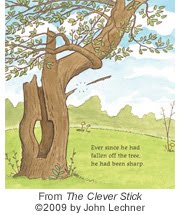
This month I'm celebrating John Lechner! He's here today to share some insights about being an author/illustrator, and he knows what he's talking about. John is a multitalented illustrator, author, animator, designer, puppeteer, and musician. He has four books to his credit so far, A FROGGY FABLE, THE CLEVER STICK, STICKY BURR: ADVENTURES IN BURRWOOD FOREST, and STICKY BURR: THE PRICKLY PERIL all published by Candlewick Press, as well as loads of great interactive material. Currently John is the art director at Peter H. Reynolds' children's media company, Fablevision. I'm very happy to feature John as April's Illustrator of the Month.

I assume people with great artistic talent always had it. Were you always good at drawing, even as a kid? When did you know you wanted to create children’s books?

I’ve always loved to draw, and I was always encouraged as a child. I wrote and illustrated my first book in first grade, about explorers who fall into the ocean and escape from a whale. I always loved books and wanted to be an illustrator like those I admired (Maurice Sendak, N.C. Wyeth, Bill Peet, Arthur Rackham.) I studied art and creative writing in college, but didn’t really find my voice until much later.


How did you develop your illustration style?

It just developed naturally over the years, it’s an odd mixture of naturalistic watercolors and simple line drawings. As I became more busy through the years, I drew faster and that helped to free up my style. I think it also comes from the things you draw, and since my stories often involve animals or nature, that also influences my style. I don’t like drawing buildings, I’m more at home in the forest.


When both writing and illustrating a book, which comes first for you, the story or the art?


The words usually come first. I might draw a quick sketch to set the scene in my mind, but I usually write out the story as it comes into my head. When I get a story idea, I don’t think about whether it might be a book, I just write the story and see where it goes. Some ideas don’t go anywhere, but sometimes they end up better than you thought. If I think a story has potential, I might create a web version to try it out. That’s how A Froggy Fable and The Clever Stick got started.


When submitting a book as the author/illustrator, do you complete the illustrations before submitting or do you submit a dummy?

I usually submit a rough sketch dummy along with the typed manuscript. A picture book typically evolves a lot from the time it is accepted until the time you do the final illustrations. The publisher will want to consult with you on the text, the size of the book, the number of pages, and the layout. So illustrating the entire book beforehand is not practical.


The purpose of the sketch dummy is to convey your vision of the book, and give the publisher a rough idea of how it might read. But when your book is accepted by a publisher, their designer will likely make a new dummy with suggestions for making the layout stronger, just as your editor will make suggestions for strengthening the text. There is a lot of discussion and revision before the final layouts are ready and you can start the final illustrations.


Your STICKY BURR books are part picture book, part comic book. What made you decide to go that route for these stories?

I originally envisioned the burrs as comic characters, because I wanted the stories to have a lot of action and visual humor. I started doing the Sticky Burr web comic over ten years ago, which has evolved into the current version you see today. I envisioned the books as a combination of a comic and a picture book because I wanted them to be a little different. By inserting pages of Sticky Burr’s (or Scurvy Burr’s) journal throughout the comics, it not only allowed me to elaborate on the characters and their world, but it also provided a nice break in the story, making it easier to suggest the passing of time or changing of location, which otherwise would have been harder in such a short comic. I added the map and other things to help create an entire world for these characters.


I have to ask. Why a burr?

When I was young, my brothers and sisters and I would spend a lot of time in our backyard. It had squirrels, birds, dragonflies, grasshoppers -- a bit like Burrwood Forest. We also had bushes that grew burrs on them, and we always called them sticky burrs. It wasn’t until I was an adult, and thinking back to those years, that I thought the burrs would be great characters. I started writing stories about them, and they evolved into the world you see today.


Do you think it’s easier as both the author and illustrator of a book to get your story across?


Personally, I enjoy having control over the story and illustrations, because I tend to think of them together. I visualize the images in my head as I write. Though there are also advantages to working with someone else, as they often think of ideas that you didn’t.


You also create films and interactive games. Does this take a whole different skill set or does it complement your book writing and illustration work?


Like books, films and interactive games also involve storytelling with images, but it’s really a different way of thinking. You’re thinking in real time, with real pacing. The storytelling techniques are different too. That’s why picture books that use still images from a film usually fall flat, because those images weren’t meant to stand alone, they were meant to be shown in connection with a thousand other images. So as an artist it can be challenging to shift from printed books to films and interactive stories, as you have to shift your brain into another way of thinking. But they all can inspire and influence each other.


Continuity of the looks of the character is so important. How do you achieve this page after page?

Continuity is very difficult, it takes a lot of erasing and comparing images side by side. However, you also don’t want to be too tied down to making your characters perfect, you also want them to be alive. Some of my favorite illustrators hardly have any continuity, yet they have so much life and energy in their art (Ludwig Bemelmans is a perfect example.) Continuity of style is often more important than continuity of specific characters. As long as the world you create is consistent throughout, the characters will appear more consistent.


If you use an additional illustrated story line in a book, do you decide on it purposefully or does it grow organically?

It’s different with every book, but usually it happens in the illustration stage. For instance, in Sticky Burr: The Prickly Peril, there are two burrs that both want to juggle, and one of them steals the juggling balls from the other. In the final page, they are seen juggling together. This is totally unrelated to the main storyline, yet it helps reinforce the malcontent of the burrs early on, and the camaraderie they feel at the end.


What advice would you give to aspiring author/illustrators trying to break into the market today?

It’s a very crowded field, but it’s also an evolving one because of new media and markets. Networking is one of the best ways to get connected with people in the field and get seen by an editor or art director. SCBWI conferences are great, and there are so many writer conferences and comic conferences where you can meet people and learn from them. Keep an eye out for new small publishers, which are often more receptive to new authors. Don’t be afraid to try new things, such as ebooks or web comics. And never stop working and improving your art, try to work twice as hard as everyone else.


Want to tell us about what you’re working on right now?

I’m finishing up my first novel, which I hope will find its way to publication. I’m also drawing a weekly web comic about Sticky Burr and his continuing adventures. I also have a blog about art and nature called The Untended Garden, where I write about how artists and writers are influenced by nature.


I’ve also been working on an interactive story, something that combines my interest in books, animation and interactive games. It’s a story without words, where the user advances the action, following a character as he journeys through a mysterious and deserted world. Although it’s interactive, it’s still a fairly linear story, with a beginning, middle and end. I’ve always been interested in the possibilities of interactive storytelling, and trying to push the boundaries of what can be done. I hope to unveil the project this spring.

You can learn more about John and see tons of his work at his website, http://www.johnlechner.com/ And check back this month for more from John!


Tuesday, February 9, 2010

Interview with Susan Marlow, author of the Circle C Adventure series

Susan K. Marlow has found a way to combine three things she loves: horses, adventure, and writing. She's the author of the Circle C Adventure series published by Kregel Publications. Susan has frolicked by to talk about writing series, book promotion, and her latest Circle C Adventure, TROUBLE WITH TREASURE. You can learn all about Susan's main character, Andi, at Susan's great Circle C Adventures website. But don't leave here before entering Susan's giveaway! Details are at the end of the interview. There's real gold involved!

First, I have some questions for Susan along with a big CONGRATULATIONS on the new book release! Hooray! Now, my daughter and I are dying to know, what sort of adventure is Andi going to have in her new book, Trouble With Treasure?


Well, right off the bat, through no fault of her own (for once), Andi ends up in jail! A little horseplay with a leaky water trough in town brings the unfriendly new deputy swooping down on Andi and her friends. She’s hoping a two-week trek into the Sierras to pan for gold will put all her troubles behind her. But Andi and her friends are so wrong. They tangle with a rattlesnake, a couple of “two-legged” snakes, and a seriously injured brother. Toss in a couple of bags of bank gold and being stranded in the wilderness, and that spells “trouble” in a big way.


Where did you get the idea for this story?

I originally wrote the basic story years ago, and it looked much different from what it is today. I wanted a story that highlighted Andi and the youngest of her older brothers, Mitch, who hadn’t been in the other books much. I wanted Andi to be stuck alone in the wilderness and responsible for saving her brother’s life. But it was just Andi and Mitch, and it didn’t work so well, especially when Mitch was unconscious a good deal of the time (it cuts into your dialogue opportunities). So I rewrote it to include Andi’s friend Jenny (from Book 4) and her good pal, Cory, and expanded the story into a couple of different directions.


When you sold your first Circle C Adventure, Andrea Carter and the Long Ride Home, you didn’t know it would become a series. How difficult was it to develop more stories for Andi?


I didn’t know it would become a series, but I was sure hoping it would. I had the first three stories already written (though I’d call them very rough drafts now). It wasn’t difficult to revise and submit those. But book 4 was totally new material, and it was tough filling in the blanks and making the story “work.” I wanted a story set in San Francisco for Book 4, but what in the world was going on in that city in 1881? So it took a lot of time to do the research and weave that research seamlessly into the book.


How did you learn to write series?

By watching TV during the 60s, mostly. Television shows are basically “series,” where your favorite characters have complete, new adventures every week. Without realizing it then, I fashioned my stories after shows like Star Trek. I knew there was a “teaser” opener (to keep people from changing the channel), scenes that always ended on a cliff hanger (to keep people from changing the channel), the “dark moment” or climax, and the satisfying ending. I knew and expected certain things from the characters. They interacted in a fun way. They never acted out of character. They evoked an emotional response in an impressionable young teen, and I made sure my first stories did the same thing. I guess I learned from observing.


Do you have any tips for aspiring series writers?

I believe that the most important element in a series is an engaging, likeable main character with whom young readers can identify. One young fan recently wrote me a letter and said, “Sometimes I pretend I’m Andi, riding and talking to Taffy.” Obviously, this young reader has connected with the main character. For her, it probably doesn’t matter what kind of adventure Andi and her horse have, so long as Andi invites the reader to become part of the story with her. It’s the character whom readers want to follow along on the journey. So make the development of your series’ “star” your most important consideration when thinking about writing a series.


You are an amazing book promoter. What are you doing to promote Trouble with Treasure?

You mean besides chatting with you and your readers? *grin* I have my usual bookmarks, postcard mailings, and Ezine campaigns. I have a growing fan list on the Circle C Adventures fan page on Facebook. I give away a lot of books through contests and sites on the web. I speak at Young Author conferences and do some school visits. And this year I’ve decided to have a booth at various homeschool conventions on the West coast.

I send out books for reviewers to review, and I created a book trailer, which I posted on Facebook. Then I asked a number of FB friends to “share” it on their profiles. This way my books and my name keep popping up, a little at a time. Unfortunately, this takes a lot of time, and it keeps me from writing.


How important do you think it is that authors promote their books?

Very important! On a scale from 1 – 10, the importance of partnering with your publisher to promote your books is probably a 9.5. I honestly believe that the reason I have six books in my serious (as opposed to two or maybe three) is because I have spent a significant amount of time (and money) getting the word out. The good news: it really does help. The bad news: it never ends. You can never stop, because once you stop promoting your book, people forget about it. The nice thing with a series is that a new book automatically promotes the other books in the series. This keeps what would ordinarily be a five-year-old back-listed book fresh for new readers.


What is one of the most fun things you’ve done to go along with your books?

I like doing contests on line and at conferences. I put a bunch of little plastic horses in a big jar and have a Guess the Number of Horses contest. The winner receives a Beanie Baby horse keychain, some real gold, a Chinese doll, or even a book, depending on which book I’m promoting at the time. The other fun thing is tying up a “set” of books with colored elastic string, along with a plastic horse, and selling them at a discount. They sell like hotcakes and they look so cute!


You say you’re a shy person, yet you do quite a bit of public speaking, from teaching kids to talking at author events to radio interviews. How have you learned to do public speaking?

Being a teacher and loving kids has been a “key” to making it through public-speaking venues. I’m comfortable around kids (my peer group) so of course school visits and writing workshops are my favorite kinds of events. For big groups (like school assemblies) I have found that a well-crafted PowerPoint presentation saves the day every time. It can be shortened or lengthened right at the time, depending on interest level and/or time available. Holding the remote is like clutching a security blanket. But outside the kid audience, I’m afraid I’m hopeless. The way I have learned to “do” public speaking in those cases (speaking to adults and doing radio) is by plunging ahead and saying, “Yes, I’ll do it,” and then taking a step of faith that God will see me through as long as I’m prepared. It’s totally nerve-wracking, and I don’t like it, but so far, God has seen me through.


Will we be seeing any more of Andi after Trouble with Treasure?

Oh, yes! Andi has one more adventure in this series, Andrea Carter and the Price of Truth. A quick blurb: Andi’s eyewitness testimony places a beloved citizen at the scene of a crime. Will the price of telling the truth be too high if it means losing Taffy forever? But Andi and Taffy’s adventures are not over. I’m writing a series of chapter books for young readers (grades 1-3) about Andi and Taffy when they were young. Those books should hit the market a year or so from now.


I’d ask you what book you would live in if you could, but I imagine you’d be right in there with Andi, or cruising outer space with the Star Trek crew. Am I totally wrong?

Heather, you know me too well! To be honest, I can’t decide which world I’d rather live in: the Old West or aboard the starship Enterprise. Either one is a journey of imagination that “. . . boldly goes where no [kid] has gone before.”


Susan is going to giveaway an autographed and personalized copy of Trouble with Treasure to one lucky winner. Plus she's throwing in a vial of real gold! What do you have to do to win? Just leave a comment on this here interview. If you tweet, blog, or facebook the contest and let me know I'll add another entry. U.S. residents only. Contest ends February 16th at midnight. Good luck!

Sunday, November 29, 2009

Retold Tales

Retold Tales are fun! Most of us are familiar with classic stories and nursery rhymes, but even if we're not, new twists and retelling can be great reads. I especially love them for storytime. I went searching for retold tales on my library shelves. Here's what I found and put on display:


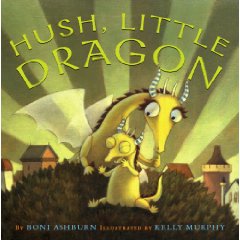
Hush Little Dragon written by Boni Ashburn and Illustrated by Kelly Murphy. A mother dragon soothes her baby by singing him a rhyme. A fiendishly fun play on the Hush Little Baby lullaby, this mama dragon sings about snacks of the royal kind.


Young MacDonald by David Milgram in which Young MacDonald creates all sorts of mixed-up animals on the farm while the Old MacDonalds are away. He's got to set thing straight before the Old MacDonalds, aka his parents, get home.


Goldie and the Three Bears written and illustrated by Diane Stanley. Goldie can't seem to find a friend that is just right, until she happens upon Bear's house. Both the illustrations and the story are very sweet.


The Famous Adventures of a Bird-Brained Hen is written and illustrated by Jessica Souhami. It's a simple retelling of Henny Penny's story with colorful collage illustrations.


The Adventures of the Dish and the Spoon by Mini Grey. This book takes a couple of characters from the classic nursery rhyme. It's great fun. The Dish and the Spoon run away together and become vaudeville stars, of course, there is some trouble along the way.


Tom Thumb retold and illustrated by Richard Jesse Watson is a beautiful book. Mr. Watson's amazing illustrations alone make it a must read. There is so much detail! I actually have a signed copy of this book from when Mr. Watson visited our library. In it he drew a big beautiful lion for my son(amazingly quickly I might add). It's a book that we treasure.


Bubba the Cowboy Prince: A Fractured Texas Tale by Helen Ketteman and illustrated by James Warhola. Bubba is the "Cinderella" of this tale. He's the stepson of a wicked rancher and has some really mean stepbrothers and the fairy godmother is a cow. This is one of my absolute favorite stories. The voice is spot on. It'll have you talking like a cowboy in no time.

I'd love to know what your favorite retold tales are.

Wednesday, October 14, 2009

Ghosts in the House!

I've found a new Halloween favorite to put on my annual Halloween reading list--my favorite annual reading list, but really, it's a good book for any time of year. Ghosts in the House! by Kazuno Kohara is just about as cute as can be. A little girl and her cat move into a house, there is only one problem, you guessed it--there are ghosts in the house! Luckily this little girl isn't your average little girl, she's a witch. She has no problem rounding up ghosts. She even hopes for more. Did you know how how useful ghosts are after you wash them and hang them up to dry? They're amazing. You can make curtains, tablecloths, and blankets, and they have these sweet little faces on them.


Kazuna Kohara's art in this book is fantastic. The black on orange illustrations are perfect, and the ghosts float right over the top of everthing. You can see through them, just like you should. They are ghosts after all.

Ghosts in the House! written and illustrated by Kazuno Kohara, is published by Roaring Brook Press. (Sorry I couldn't get the cover photo any bigger. I'm graphically challenged.)

Tuesday, October 6, 2009

STAR OF THE SHOW - Della Ross Ferreri talks about her new book!

I love to feature writers and make them the star of my blog. How fitting it is that today I have Della Ross Ferreri, author of the new book, STAR OF THE SHOW. Della is the author of two beginning readers and her picture book, HOW WILL I EVER SLEEP IN THIS BED? was popular enough that Sterling Publishing reprinted it in board book format. Della has frolicked over today to talk about her brand new book and, of course, writing.

Congratulations on your book release, Della! What is STAR OF THE SHOW about?


STAR OF THE SHOW tells the story of a bossy big sister, Francine, and her tag-along brother, Max. When Max has the idea of putting on a circus, Francine immediately appoints herself the star of the show, and designates Max the assistant. Max gets fed up with Francine always getting the best part. This time, he wants the spotlight, too. But can Francine give up center stage? Through argument, compromise and imaginative play, they finally come together to present a wildly successful circus! It’s a fun story of sibling rivalry that kids can relate to, and, from what I hear, parents and teachers appreciate how the characters they end up working things out. I’ve received great feedback on the ending!


What inspired you to write this story?

My kids are the inspiration for most of my writing. My oldest daughter went through a bossy phase and took it out on her little sister. Whether it was dancing, playing school, or putting on a show, daughter #1 always took the lead role. In STAR OF THE SHOW, I exaggerated this personality trait. My character Francine is waaaaay more obnoxious than my daughter ever was. lol


What do your kids think about being the inspiration for this book?

They think it’s funny! They have fun remembering their playtimes together!


Which of the characters in STAR OF THE SHOW are you like, Francine or Max?

Hmmm, I guess I’m a little of both. Sometimes I take charge and run the show, but other times I don’t mind sitting back and letting someone else be in the spotlight.


What was your road to publication like for STAR OF THE SHOW?

In one word – LONG. We’re talking two to three years of submitting and revising. If you want the full story, here you go. The original version of STAR OF THE SHOW started out as an assignment for the Institute of Children's Literature. I sent it around and it went through a couple revision requests w/an editor, but ultimately was passed on. The story became stronger, though, so I am grateful for the editor’s time. Thank you, Shari. Then I shared the revision w/my Sterling editor and she thought it was funny and brought it to acquisitions. But Sterling already had a circus themed book (Tightrope Poppy) and a book with a similarly bossy, selfish character (Mine, Mine, Mine.) They also offered some helpful revision suggestions that I followed. Thank you, Heather, and folks at Sterling!

Then, STAR got critiqued at the Rutgers one-on-one conference and that helped tremendously, too. One problem that needed work was that Francine didn’t have a strong reason/motivation to change her mind and let Max participate in the show. I took my mentor’s advice and had Max get so fed up that he walks out, leaving Francine to struggle and feel the pain of failing to be able to put on a circus by herself. Thank you for that, Alexandra!

Then, after rounds of tightening and suggestions from my critique groups, (Thank you, Sparks and Pearls and my local ‘Soup Group!’) I came across somewhere on Verla Kay’s Blueboard, a mention of the Children’s Book Council list of publishers. That’s where I discovered Shenanigan Books. I submitted STAR OF THE SHOW in September 2007, and got a ‘we’re interested’ email a couple months later. Once the illustrator was finalized, I was offered a contract. Fast forward two years, and here we are, fall 2009 and Ta da! STAR OF THE SHOW is out! Thank you, Shenanigan Books!


Do you have a submission strategy?

Yes, I’m very persistent! I leave no stone unturned, and I’m willing to rewrite and reformat if a piece isn’t working in its present form. STAR OF THE SHOW went through dozens of rewrites. One of my other books, HEY! YOU’RE EATING MY HOMEWORK started out as a 900-word picture book, and I whittled it down to a 300 –word beginning reader that was eventually accepted at Bebop Books. My other book, HOW WILL I EVER SLEEP IN THIS BED? started out as a short poem that grew into a story with beginning, middle, end and a conflict for the main character to solve. It grew from three stanzas into a full-fledged picture book. So you see, I believe it’s important to be open-minded to the possibilities of what direction to take your stories.


What are you working on now? What are your plans for the future as far as your writing career goes?

I’m working on a sequel to STAR OF THE SHOW. I also have a few manuscripts making the rounds. One rhyming story is under consideration at a major house, so fingers crossed on that! I’ve had a couple deals fall through over the past couple years so it’s been a bit of a rollercoaster ride. Since I’m back to teaching, and keeping busy juggling my kids’ sports schedules and activities, sometimes it’s hard to squeeze in the writing.


You have been a part of Verla Kay’s online children’s writer’s community for a while now. How has being part of an online writer’s community helped you?

I love the Blueboard! It offers camaraderie and support, and I’ve made some wonderful connections and friends. Verla is the most generous and caring person of all. She even helped critique STAR OF THE SHOW in its earlier stage. Thank you, Verla!


What advice would you give to aspiring writers?

Read a ton of books in the genre you wish to write. Join a critique group. Be patient. Let your stories simmer before sending them out. Be open to taking your stories in different directions.


What is it about writing picture books that appeals to you?

I love to think visually and picture the scenes as I write. Plus, picture book readers are at such a great age. I love their fresh view of the world and their developing sense of logic. I’m probably a 6 year old at heart!


This is the question I love to ask everyone. If you could live in any book, which one would it be, and why?


Two of my little guy’s favorite night time books lately are KISS GOOD NIGHT and YOU CAN DO IT, SAM by Amy Hest, illustrated by Anita Jeram. In the midst of all the nuttiness of teaching, writing, and juggling my family’s sports and activities, I would love to take a break and settle into the simple, cozy life portrayed in these gorgeously illustrated picture books.


What are you doing to support the publication of STAR OF THE SHOW?

I’m trying to get the word out as much as possible. I have a series of events lined up for this fall…story times, writing classes, and other bookstore and library events. The photograph I sent along was taken at Millbrook Community Day. My friend, Jackie, aka BeeBee the Clown, came out to entertain the kids and help promote my book. She took an ordinary event and truly made it extraordinary! Thank you, BeeBee! I sold a bunch of books that day, sponsored by my wonderful local independent book store, Merritt Books. Next stop is Barnes and Noble in Poughkeepsie for Educator Appreciation Day on October 10, and then a Charity Event on October 23 at the Putnam Hospital Center. Folks can check out my website for the dates and locations of events in NY: www.DellaRossFerreri.com

STAR OF THE SHOW is illustrated by Tony Weinstock and published by Shenanigan Books.

Wednesday, September 16, 2009

The Big Debate

Who Should Control The Virtual Library? This is a great interview with a Google representative on NPR's talk of the nation that I know will interest all my writer friends. Google wants to scan books and make them available online. They want writers to have to opt out. The interview is about 20 minutes long. I love the writer that called in.
Click here to go to the interview.

Saturday, September 5, 2009

Who Are the People in Your Neighborhood?

For my picture book display at the library this week, I tried to go with a Labor Day theme. It proved to be a little difficult, but I managed to come up with a fun display. After all, there are lots of different kinds of workers in any given place. My people in the neighborhood list includes firefighters, postal workers, a garbage man, store clerks, a librarian, bakers, musicians, a principal, a Zamboni driver, and of course, a mad scientist. Here’s what I found:


TRASHY TOWN written by Andrea Zimmerman and David Clamesha, illustrated by Dan Yaccarino. This is a classic story about the trash man with a great rhythm plus it encourages child participation, which is always fun. If you haven’t read it, what are you waiting for?


FIREFIGHTERS TO THE RESCUE by Kersten Hamilton and Rich Davis. A firefighter story. Kids love em.

PENGUIN POST by Debi Glori, about a little penguin who has to take over delivering the mail for his penguin parents—and ends up delivering himself a surprise.

BEBE GOES SHOPPING written by Susan Middletown Elya, illustrated by Steven Salerno. I know, I’m pushing it with this one, but there is a grocery store clerk in it, and he’s very nice.

NOTHING by John Agee. This story has a funny concept that challenges our way of thinking. Buying nothing? Absurd!

THE LIBRARY DRAGON by Carmen Agra Deedy. Hey, every librarian’s got to be a little bit of a dragon sometime, except for me, of course.

HAZEL NUTT: MAD SCIENTIST written by David Elliot and illustrated by True Kelley. Every town has a mad scientist, doesn’t it?


SUN BREAD by Elisa Kleven. Elisa’s books are always beautiful. And there’s a baker in this story that brings the whole town together.

MY FAMILY PLAYS MUSIC by Judy Cox, illustrated by Elbrite Brown. Where would we be without musicians?

SAM THE ZAMBONI MAN written by James Stevenson, illustrated by Harvey Stevenson. The Zamboni man is especially important around here. Lots of hockey lovers.

MR. TANNEN’S TIE TROUBLE by Maryann Cocca-Leffler. Mr. Tannen is one tie loving principal. I wish he would have been my principal when I was in school. He’s awesome.

I wanted to include police officers(Like OFFICER BUCKLE AND GLORIA by Peggy Rathman), doctors, dentists, truck drivers, teachers, the list could go on and on. Any favorites out there I should keep in mind for my next people in the neighborhood display?

Tuesday, September 1, 2009

Interview with Author/Illustrator Carin Berger

Have you ever seen a book cover and fallen in love with it? That's what happened the first time I looked at Carin Berger's picture book, OK GO. The bright, whimsical characters made me want to pore through the book and see what it was about. I wasn't disappointed.

Carin is an award winning illustrator, author, and designer. Her latest book, OK GO, was published by Greenwillow Books this spring. It is a beautiful book about going green, full of wonderful images made with recycled materials and inspiration for kids (and their grown-ups) to do their part to help take care of the environment. Carin has stopped by today to talk about her writing and her beautiful collage illustration style, and I am so happy to have her!


Which comes first for you, the story or the art?

The story or at least the idea for the story almost always comes first.


I love your quirky collage illustration style. How did you develop it?

When I first started playing around with illustrations for a set of poems that I had written [what was to become Not so True Stories and Unreasonable Rhymes], I thought that I would make paintings. But then a friend, who knew I had a passion for ephemera, gave me a box from an old barn that was brimming with a half century’s worth of old papers. It was an absolute treasure trove calling out to be used and it set me on the path to collage.


How does your process of collage work?

I start by making thumbnail sketches and then tiny dummies of the book. Once everything is working I do very tight full size final line drawings which look very different than the final collages. I then make each section of the collage and put it together almost like a puzzle. I might cut five different cars out before I have the one in the color and gradation that I’m happy with. The materials that I use are very pedestrian. In addition to the ephemera [which might be something old but could also be the receipt from the dry cleaner with great printed numbers on it], I use old magazines and catalogs. [Clothing catalogs are a great source for buttons!] I also use plain white glue and scissors and my trusty x-acto knife. Sometimes I add a bit of paint to the background.


Are there any artists whose work inspires you?

Oh yes! There are so many it’s hard to know where to start. I look at absolutely everything for inspiration. Paintings, textiles, furniture design, architecture, folk art, photography, old scientific inventions…

I love the work of Hilary Knight, Charley Harper, Bill Peet, Jonny Hannah, Calef Brown, Lane Smith, Sara Fanelli, Maurice Sendak, Mary Blair, Takei Takeo, and Helene Guertik, to name a few favorites.


About how long does the process of writing and illustrating a book take you?

It varies. Ideally I like to have 5-6 months for a project.


You illustrated BEHOLD THE BOLD UMBRELLAPHANT by Jack Prelutsky. Can you give us some insight on how illustrators are paired with manuscripts?

That’s a bit of a mystery to me. The art director at a publishing company is responsible for making those decisions.


When did you know you wanted to be an illustrator? What drew you to children’s books?

I’ve always been smitten with children’s books. I love how the words and pictures work in tandem to tell a story. I made my first picture book for my cousin when I was 10. And I started collecting them back then as well.


Have you had any artistic training? Any training for writing?

I studied graphic design and illustration at college, and I have worked as a designer in London, New York City and San Francisco. For the last decade or so I have designed book jackets, which I still enjoy doing along with making picture books. Writing is something that I have always done for my own amusement.


What advice would you give to aspiring illustrators?

I think it’s important to do what you love, and to allow yourself to experiment and to find your own “voice”.


Your first picture book, NOT SO TRUE STORIES AND UNREASONABLE RHYMES, was published by Chronicle Books in 2004. How did you break in to the market?

I was tremendously lucky. I had a set of poems that I wrote and illustrations that I made to go with them, but I didn’t really know what to do next. A writer friend suggested that I send them to an agent that he knew. She generously took the project on, and, miraculously, managed to sell it. That became my first book, Not so True Stories and Unreasonable Rhymes, Chronicle Books, 2004. It was a very fluid process, and, I now realize, atypical and extremely fortunate.


What inspired you to write your latest book, OK GO?

Remember “Give a Hoot, Don’t Pollute” from the 70s? I do. That early message to be responsible for the environment somehow resonated deeply for me. I think that kids have a very strong moral compass and an intuitive connection to nature. It’s great to reinforce that. Plant the environmental message early!


What are you hoping readers will get out of the story?

First, fun.

Second, the opportunity to start a discussion about taking care of the planet, and, hopefully, some passionate young green advocates!


What are you doing to support the publication of your book? Where can we find you?

I find visiting schools and doing readings very rewarding.

Also, I have a website: www.carinberger.com

and a fan page on facebook: Carin Berger

and I’ve met all sorts of interesting people on twitter: http://twitter.com/CarinBerger


What’s next for you?

I do have a new picture book coming out early in the new year that I am excited about. It’s called Forever Friends and it’s about enduring friendship. It’s kind of a companion book to The Little Yellow Leaf. [Hint: look at the front and back covers of The Little Yellow Leaf and you will find the two friends in Forever Friends!]


That's exciting news, Carin. You have a definite Little Yellow Leaf fan here at my house. My little guy loves tracing the path of the yellow leaf and his friend as they dance through the sky. We'll be waiting for Forever Friends.

Want to know what else Carin is up to? Stop by her blog: carinberger.blogspot.com